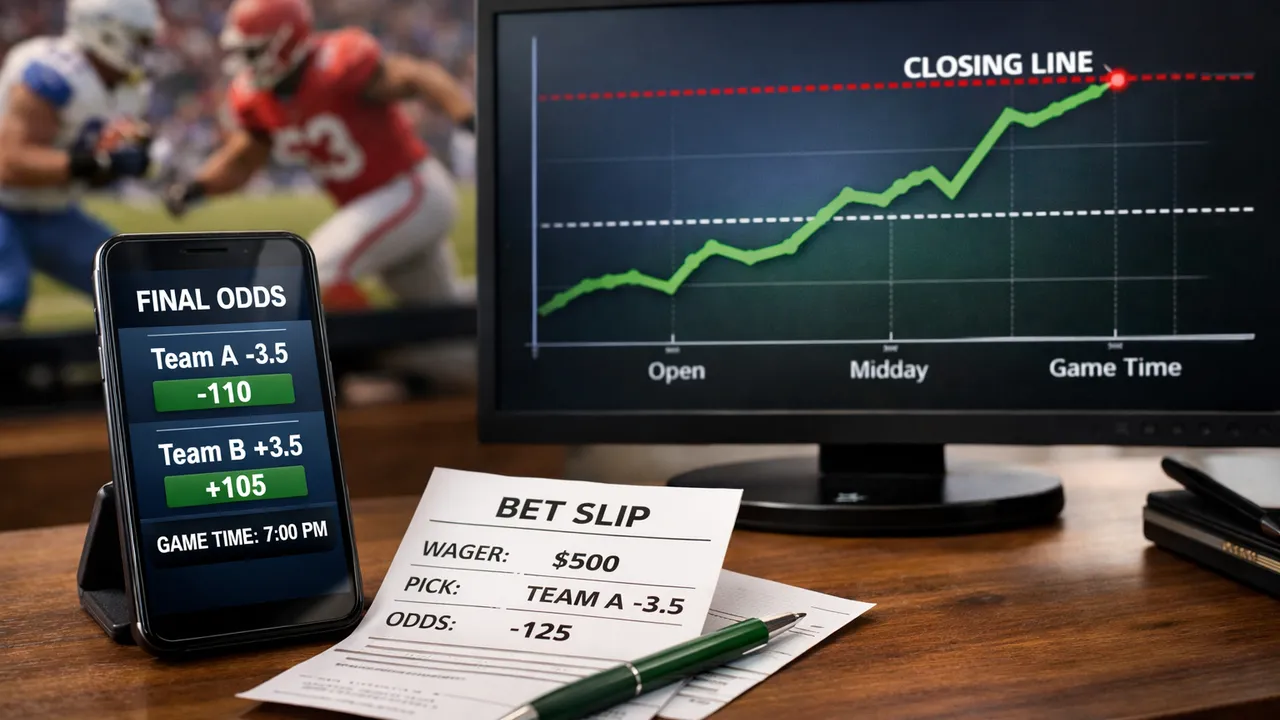
Closing Line Value, or CLV, measures the gap between the odds you took and the final market price at kickoff, tip-off, or first pitch. In serious betting analysis, that gap matters because the closing line is usually the sharpest estimate the market produces. If your number beats the close on a consistent basis, your process is usually stronger than your short-term results suggest.
That does not make CLV a magic answer. It is a tracking tool, a quality check, and a way to separate good decisions from noisy outcomes. Used correctly, it helps bettors judge timing, line selection, and market awareness with much more precision than a simple win-loss record.
What Closing Line Value actually measures
Closing Line Value measures whether you got a better price than the market’s final consensus. In practical terms, a bettor who takes Team A at 2.10 and sees that price close at 1.95 has positive CLV. A bettor who takes 1.80 and watches the market close at 1.95 took the worse number and posted negative CLV.
The concept works across moneylines, point spreads, totals, and Asian handicaps. On spreads and totals, the comparison can involve both the line and the price. A bet on Over 2.5 at 1.97 is not identical to Over 2.5 at 1.87, and Over 2.5 at 1.97 is also not identical to Over 2.75 at 1.97. Good CLV tracking respects those differences instead of flattening everything into one rough category.
The reason bettors care is simple. The closing line absorbs the largest amount of public information, professional action, injury updates, lineup news, weather adjustments, and model-driven corrections. By the time the market closes, weak prices have usually been attacked. That is why beating the close is one of the cleanest signals that your bet entered the market at a favorable moment.
Why the closing line matters more than raw results
Short-term betting results are noisy. A bettor can make ten strong bets, lose seven, and still have a better process than someone who wins seven with poor prices. CLV helps identify that difference because it evaluates decision quality before the match result distorts the picture.
This matters most in sports with high variance. Soccer totals, baseball moneylines, tennis underdog prices, and player props can swing hard over small samples. A late own goal, a red card, a bullpen collapse, or a retirement can flip a result that was priced well. The market number gives you a more stable benchmark than a handful of outcomes.
Sharp bettors have treated closing line performance as a core metric for years. Many trading teams and syndicates judge analysts less by one month of profit and more by whether their bets consistently move into stronger closing positions. The logic is straightforward: if the market repeatedly closes below your entry on favorites or above your entry on underdogs, your numbers are probably finding value before the crowd and the professionals finish correcting the board.
| Bet type | Your price | Closing price | CLV result |
|---|---|---|---|
| Moneyline favorite | 1.95 | 1.83 | Positive CLV |
| Moneyline underdog | 2.40 | 2.62 | Negative CLV |
| Total Over 2.5 | 1.98 | 1.90 | Positive CLV |
| Spread -3.5 | 1.91 | -4.5 at 1.91 | Strong positive CLV |
How to calculate CLV without distorting the signal
Closing Line Value can be tracked in several ways, but the cleanest method is to compare implied probability rather than just decimal odds. Odds formats can hide the real size of the difference. A move from 2.50 to 2.30 is not the same as a move from 1.60 to 1.40, even if both look like a 0.20 shift.
For decimal odds, implied probability is calculated as 1 divided by the odds. If you bet at 2.10, your implied probability is 47.62 percent. If the line closes at 1.95, the closing implied probability is 51.28 percent. That means the market ended up rating your side more strongly than it did when you entered. That is positive CLV.
Some bettors prefer a simpler operational method. They log the opening line, their bet line, and the closing line, then mark each bet as positive, neutral, or negative CLV. That approach is less precise, but it is still useful if you handle large volume and want a fast read on process quality.
What matters is consistency. Use one sportsbook or one market source for the closing number, log the exact time of your bet, and separate pre-match bets from live bets. Mixing books with very different margins or comparing your soft-book price against a sharp-book close without context can produce bad conclusions.
Practical rules for tracking CLV
- Record the exact market: moneyline, spread, total, Asian handicap, or prop.
- Log the exact odds and line, not just the side you took.
- Use the same reference book for the closing number whenever possible.
- Track stake size, because tiny test bets and full-position bets should not carry the same weight in review.
- Review CLV over at least 200 bets before making strong judgments.
Where CLV is most reliable and where it can mislead
CLV is most reliable in liquid markets. NFL sides, major soccer leagues, NBA spreads, ATP and WTA main-tour matches, and top-level baseball markets usually close efficiently because they attract large volume and fast information. In those environments, beating the close means something.
The signal gets weaker in niche markets. Lower-division soccer, small tennis challengers, player props with low limits, and early lines in obscure leagues can close on thin action. A bad or lazy close is still possible there. If the market itself is fragile, CLV loses part of its authority.
Timing also changes the meaning of the metric. Early bets often show bigger CLV swings because the market is less mature. That does not automatically mean the bettor has a stronger edge. Sometimes the line simply had not processed a basic injury report or rotation announcement yet. Late bets, by contrast, may show smaller CLV but still be excellent if they exploit a final wave of overreaction.
Another trap appears when bettors chase steam blindly. If a number moves after a respected account or syndicate hits the market, copying the move at a worse price can feel safe. In reality, the value may already be gone. A bettor who follows steam too late often wins the argument in social media terms and loses the CLV battle on the ticket.
Common mistakes when bettors use Closing Line Value
The biggest mistake is treating CLV as proof that every bet was correct. Positive CLV does not erase poor reasoning. A bettor can beat the close because the market overreacted later, because one bookmaker copied a sharper shop too slowly, or because a rumor moved the price before being corrected. The metric is powerful, but it is not infallible.
Another mistake is using too small a sample. Twenty bets tell almost nothing. Even 100 bets can be noisy if the portfolio is spread across props, sides, and niche leagues. A more useful review starts once the sample is broad enough to smooth random movement and reveal whether your entries repeatedly land ahead of the market.
Bettors also misread pushes and line changes. Taking +4.5 and seeing the market close +3.5 is strong CLV even if the game lands exactly on 4 and your ticket loses. The reverse is also true. Winning a bad number does not turn it into a good bet. That distinction is where many casual records become misleading.
There is also a book-specific problem. Some sportsbooks shade popular teams, react slower to injuries, or post softer prop numbers. If you compare your ticket from a recreational book to the close at a sharp exchange, you may show excellent CLV. That can be real. It can also reflect a pricing gap between books rather than a predictive edge in your own model. You need to know which one you are measuring.
How professionals use CLV in weekly review
Professional bettors use Closing Line Value as part of a broader audit, not as a standalone scoreboard. They review whether positive CLV came from strong projections, faster news processing, better market timing, or access to softer books. That breakdown matters because each source of edge behaves differently over time.
A football bettor, for example, may notice that most positive CLV appears on injury-driven totals placed 20 to 40 minutes after lineup leaks. That tells him his edge is speed and interpretation, not broad pre-market modeling. A tennis bettor may find that underdog prices taken the night before close well, while same-day favorites do not. That points to a timing issue rather than a sport-wide problem.
Many serious bettors also split CLV by market type. Sides, totals, and props move differently. If your NBA sides beat the close by 1.8 percent in implied probability but your player props lose 2.4 percent, the answer is not to keep everything under one umbrella and hope the average looks acceptable. Segmenting the data shows where your process is sharp and where it leaks.
Another useful review is stake-weighted CLV. If your smallest bets beat the market but your biggest positions do not, confidence calibration may be off. The process finds value, but sizing decisions may be lagging behind the evidence.
What positive CLV says about long-term betting quality
Positive CLV usually points to sound long-term betting quality, especially in efficient markets. It suggests that your numbers, timing, or information handling regularly identify prices the market later corrects. Over a large sample, that is one of the strongest indicators that your process is viable.
Still, the relationship is not perfectly linear. A bettor can post positive CLV and still struggle if the edge is tiny, the bookmaker margin is high, or the market type is too volatile. The reverse can happen for short stretches as well. Someone can run negative CLV over a month and still show a profit because results arrived in the right order. The key is not to confuse temporary outcomes with process strength.
In practical terms, many experienced bettors view sustained positive CLV as a health check. If the market repeatedly closes against your number, your model may be stale, your injury inputs may be late, or your league knowledge may be weaker than you think. If the market repeatedly closes in your favor, the process deserves patience even through rough variance.
How to use CLV without becoming dependent on it
Closing Line Value works best when it supports disciplined review. It should not replace handicapping, market context, or post-bet analysis. The right approach is to use CLV as one core metric among several that describe decision quality.
A practical framework looks like this:
- Track CLV for every pre-match bet with one consistent closing source.
- Separate major markets from niche markets in your review.
- Compare CLV with actual results over rolling samples of 200 to 500 bets.
- Flag bets that won despite bad CLV and bets that lost despite strong CLV.
- Study why the market moved, not just that it moved.
This approach keeps the metric grounded. It also protects against two common bad habits: celebrating every winning ticket as proof of skill and dismissing every losing run as bad luck. CLV gives structure to that review because it asks a harder question than who won the match. It asks whether your number was good when the market finished its work.
For bettors who want a serious read on their process, that is the point. Closing Line Value does not predict every result, and it does not excuse weak analysis. What it does provide is a market-based benchmark that cuts through noise. If your bets regularly beat the close in strong markets, you are usually doing something right. If they do not, the market is giving you feedback you should not ignore.